Why hold 30-minute sit-ins every month? Nagasaki A-bomb survivor explains his resolve
(Mainichi Japan)
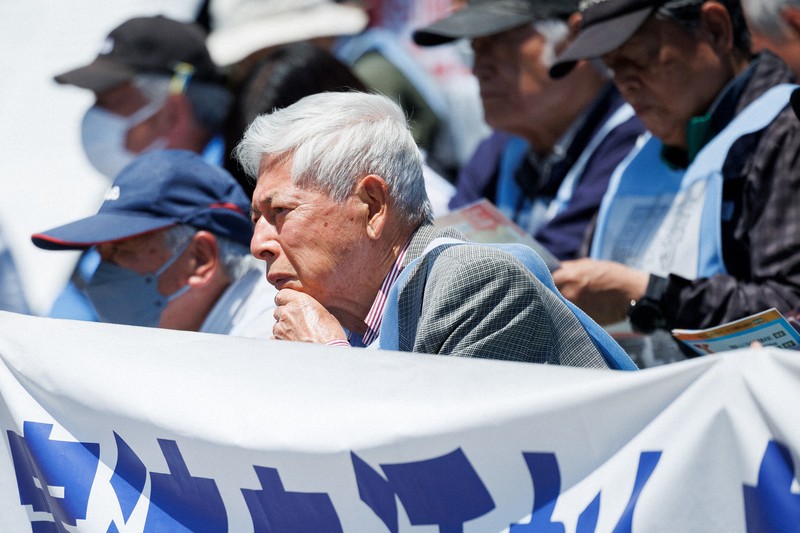
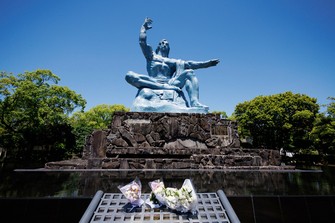
NAGASAKI -- Shortly after noon on May 9, about 100 people including Koichi Kawano, an 84-year-old atomic bomb survivor, or hibakusha, from the Nagasaki Prefecture town of Nagayo, sat in front of the Nagasaki Peace Statue holding banners including one that read, "Force does not create peace." Foreign tourists looked on with curiosity.
The group was taking part in an anti-nuclear sit-in held on the ninth day of each month by organizations including the prefectural Peace Movement Center to mark the Aug. 9, 1945 atomic bombing of Nagasaki. On June 9, 2024, the 500th sit-in will be held.
The sit-ins began in Nagasaki on March 16, 1979 at the initiative of labor organizations in Nagasaki Prefecture initially to protest the arrival of the nuclear-powered ship Mutsu at Sasebo Port in Nagasaki Prefecture for repairs on Oct. 16 the previous year after a radiation leak accident. Mutsu left Sasebo in August 1982, but the sit-ins continued on the 9th of every month after that.
Kawano started participating in the gatherings about 20 years ago. He had worked for the prefectural government and as a labor union official, and after stepping down as chairman of the Rengo Nagasaki, the local branch of the Japanese Trade Union Confederation, he finally found the time to travel to the lunchtime sit-ins. Since then, through hot and cold weather, and even on days of heavy snow, he has taken part in the sit-ins whenever he could, joining fellow protesters.
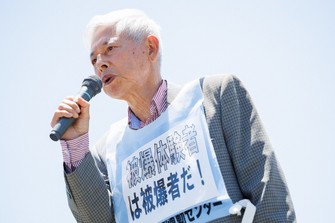
The driving force behind his participation is his belief that "war must never be waged again."
At the event on May 9, Kawano took the microphone, and warned against Prime Minister Fumio Kishida's promise to strengthen cooperation with the United States on the security front, saying, "If things continue like this, Japan will be sacrificed for America's sake. We cannot allow that by any means."
Great-grandmother's bones charred black
On Aug. 9, 1945, Kawano, aged 5 at the time, was on a road 3.1 kilometers from the hypocenter of the atomic bomb that would soon devastate the city. Hearing the roar of an airplane, he and his friend wondered, "Where is it flying?" and guessed that it was a friendly plane, but then Kawano was suddenly blown away by the bomb blast and lost consciousness. He says he doesn't remember the flash or the boom.
He regained consciousness after being awoken by a junior high school student who was covered in blood. That night, looking out from the mountains where he had taken refuge, he saw the city burning and felt, "It's all over."
A female student who lived in the house across from Kawano's escaped injury and returned home, but several days later she died after coughing up blood, apparently from radiation sickness. A student from Kumamoto who lived in a nearby dormitory and commuted to a munitions factory he had been mobilized for went missing, and his parents came searching for him but never found him.
Kawano's great-grandmother died in Nagasaki's Urakami district near the hypocenter of the bombing. In the alcove on the second floor of his home, her bones had been placed in a bucket. They looked just like burned charcoal. In the vacant lot in front of his home, bodies were cremated practically on a daily basis, and the stench of it wafted in. The adults would close the windows, saying, "They're burning again."
Moving on with a generation that has never known war
It is difficult to convey the reality of what happened 79 years ago, which is frustrating for Kawano. But at the same time, he believes, "By having generations with and without the experience of war take part in sit-ins together, we can bridge that gap, even if that's only little by little."
In months when the ninth is a holiday, high school students collecting signatures calling for the abolition of nuclear weapons also take part in the sit-ins, which encourages Kawano.
The sit-ins last for 30 minutes each month. Some are skeptical about what they might achieve, but Kawano believes, "It will form the base of a peace movement."
During a speech on May 9, the month before the 500th sit-in, Kawano said, "I want to keep going to 1,000. I get the feeling, though, that people will tell me, 'You won't live that long.'" His remarks drew chuckles from his fellow protesters. He then straightened his expression and continued, "As long as I'm alive, I want to sit with everyone and call for peace."
(Japanese original by Arina Ogata, Nagasaki Bureau)