Japan A-bomb survivor warns against US, Israeli strikes on Iran and cycle of retaliation
(Mainichi Japan)
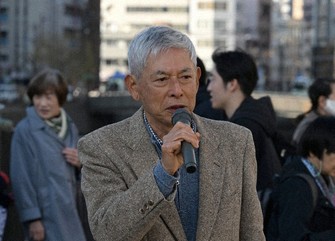
NAGASAKI -- An 86-year-old local Japanese atomic bomb survivor who once spoke to students in Tehran, Iran, was watching images of the city under attack, fearing the children he met there 19 years ago may now be among the victims.
Television footage was for days showing flames and smoke rising over Tehran after U.S. and Israeli forces launched military operations against the country.
Koichi Kawano, a resident of Nagayo, Nagasaki Prefecture, said he was overwhelmed by a sense of helplessness. "I cannot stop thinking whether the children from that time have become victims," he said.
Born in 1940 in Pyeonganbuk-do on the Korean Peninsula, now part of North Korea, where his father was posted as a police officer, Kawano repatriated to Japan the following year with his parents, to their hometown Nagasaki.
In the final phase of the Pacific War, air raid sirens warning of "enemy planes approaching" sounded almost every night, and Kawano, then 5 years old, fled into air raid shelters. On the way back from a temporary evacuation site in the suburbs to their home in the city, U.S. aircraft suddenly swooped down on them just as they emerged from a tunnel. His mother shielded him with her body and protected him.
On Aug. 9, 1945, when the U.S. military dropped an atomic bomb on Nagasaki, Kawano was on a road near his home about 3.1 kilometers from the hypocenter. He suddenly got blown away as soon as he heard the roar of a plane and lost consciousness, so "I did not even know there was a 'flash' or a 'boom,'" he recalled. He fled to higher ground in the hills and felt despair as he watched over the city engulfed in flames.
After the war, when he returned home, he saw a torn bucket in the alcove and inside it was something pitch black, like used charcoal. It was the bones of his great-grandmother, who had lived in the Urakami district near the hypocenter and died in the blast. She had doted on him and had been trying to bring him over to Urakami to live with her. "If I had gone to Urakami, I would have become that pitch-black charcoal," Kawano thought.
Kawano visited Iran in November 2007, 62 years after the bombing. Then 67, he was an executive of a nationwide antinuclear organization and had been invited by an Iranian nongovernmental organization. At the time, the war on Iraq was underway after the United States and other countries invaded Iran's neighbor. When he spoke about his A-bomb experience at a high school in Tehran, a student said, "Once the Iraq War ends, the United States will definitely attack Iran. That is why we need nuclear weapons." Kawano responded, "A chain of retaliation will not end war. The abolition of nuclear arms is most crucial."
When Kawano visited a local hospital, staff showed him medical equipment and told him, "We were saved thanks to donations from Japan." He sensed a friendly attitude toward his home country.
In Nagasaki, from 2003 Kawano threw himself into activities as chairperson of the Nagasaki Prefecture peace movement center's A-bomb survivors liaison council, known as Hibakuren. At the time he assumed the post, the group was one of Nagasaki's five major A-bomb survivors' groups, and he shared his experiences with people visiting the city. In recent years, he has met the prime minister of Japan every Aug. 9 when the leader visits Nagasaki.
Kawano is calling for Japan to join the Treaty on the Prohibition of Nuclear Weapons and for relief measures for "hibaku taikensha," or those who were exposed to the atomic bombing outside the government-designated support zones and therefore are not officially recognized as "hibakusha," or A-bomb survivors.
However, as he aged, Kawano gradually felt his physical strength was waning. He underwent surgery for esophageal cancer in 2017. Just before the Nagasaki atomic bombing anniversary in 2025, his schedule was packed with memorial events and other engagements, but he fell ill and was rushed to a hospital by ambulance. He thought he had reached his limit in continuing to put his life on the line at the forefront of the organization. In November 2025, he stepped down as chairperson when he was 85.
The "five organizations" have also dwindled to four. Of the four A-bomb survivors who headed the other groups when Kawano became chair, three have died and one has entered a care facility and is no longer active. The other remaining group disbanded after it ran out of personnel to carry on its activities.
Global tensions remain high. On the evening of March 7, one week after the U.S. and Israeli militaries began their attacks on Iran, Kawano joined a protest rally against the strikes in Nagasaki. After rounds of negotiations over Iran's nuclear development, the situation has changed and reports now spoke of children and other civilians being killed there. "Is it acceptable to treat Iran like this? I urge the United States to stop the war and abide by international law," he appealed.
Although he has left the chairmanship, Kawano has no intention of stopping his efforts as an A-bomb survivor. He wants to help halt the "chain of retaliation" in which the killing of one person leads to plans to kill even more. He wants to convey the reality of war and the atomic bomb and to have leaders around the world, including in Japan, understand the message: "Never forgive the atomic bombs, never forgive nuclear weapons, never forgive war."
On March 9, in front of the Peace Statue in Nagasaki, antinuclear groups staged their regular sit-in against nuclear weapons, which takes place every month on the 9th. "We must steadily continue efforts to eliminate wars and nuclear weapons from the world," Kawano said, as he stood among a group of participants with his back straight, holding the microphone.
(Japanese original by Arina Ogata, Nagasaki Bureau)