
datetime --- 日期與時間的基本型別
原始碼:Lib/datetime.py
datetime 模組提供操作日期與時間的類別。
While date and time arithmetic is supported, the focus of the implementation is on efficient attribute extraction for output formatting and manipulation.
小訣竅
也參考
calendar模組與日曆相關的一般函式。
time模組Time access and conversions.
zoneinfo模組Concrete time zones representing the IANA time zone database.
- dateutil 套件
帶有時區與剖析擴充支援的第三方函式庫。
- DateType 套件
Third-party library that introduces distinct static types to for example, allow static type checkers to differentiate between naive and aware datetimes.
Aware and naive objects
Date and time objects may be categorized as "aware" or "naive" depending on whether or not they include time zone information.
With sufficient knowledge of applicable algorithmic and political time adjustments, such as time zone and daylight saving time information, an aware object can locate itself relative to other aware objects. An aware object represents a specific moment in time that is not open to interpretation. [1]
A naive object does not contain enough information to unambiguously locate itself relative to other date/time objects. Whether a naive object represents Coordinated Universal Time (UTC), local time, or time in some other time zone is purely up to the program, just like it is up to the program whether a particular number represents metres, miles, or mass. Naive objects are easy to understand and to work with, at the cost of ignoring some aspects of reality.
For applications requiring aware objects, datetime and time
objects have an optional time zone information attribute, tzinfo, that
can be set to an instance of a subclass of the abstract tzinfo class.
These tzinfo objects capture information about the offset from UTC
time, the time zone name, and whether daylight saving time is in effect.
Only one concrete tzinfo class, the timezone class, is
supplied by the datetime module. The timezone class can
represent simple time zones with fixed offsets from UTC, such as UTC itself or
North American EST and EDT time zones. Supporting time zones at deeper levels of
detail is up to the application. The rules for time adjustment across the
world are more political than rational, change frequently, and there is no
standard suitable for every application aside from UTC.
常數
datetime 模組匯出以下常數:
- datetime.UTC
Alias for the UTC time zone singleton
datetime.timezone.utc.在 3.11 版被加入.
Available types
- class datetime.date
An idealized naive date, assuming the current Gregorian calendar always was, and always will be, in effect. Attributes:
year,month, andday.
- class datetime.time
An idealized time, independent of any particular day, assuming that every day has exactly 24*60*60 seconds. (There is no notion of "leap seconds" here.) Attributes:
hour,minute,second,microsecond, andtzinfo.
- class datetime.datetime
A combination of a date and a time. Attributes:
year,month,day,hour,minute,second,microsecond, andtzinfo.
- class datetime.tzinfo
An abstract base class for time zone information objects. These are used by the
datetimeandtimeclasses to provide a customizable notion of time adjustment (for example, to account for time zone and/or daylight saving time).
- class datetime.timezone
A class that implements the
tzinfoabstract base class as a fixed offset from the UTC.在 3.2 版被加入.
Objects of these types are immutable.
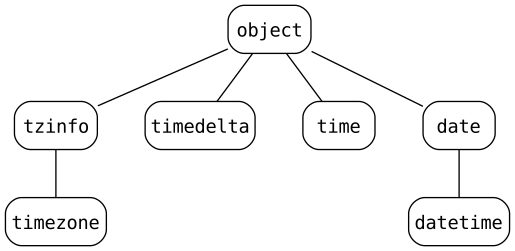
Subclass relationships:
常見屬性
The date, datetime, time, and timezone types
share these common features:
Determining if an object is aware or naive
Objects of the date type are always naive.