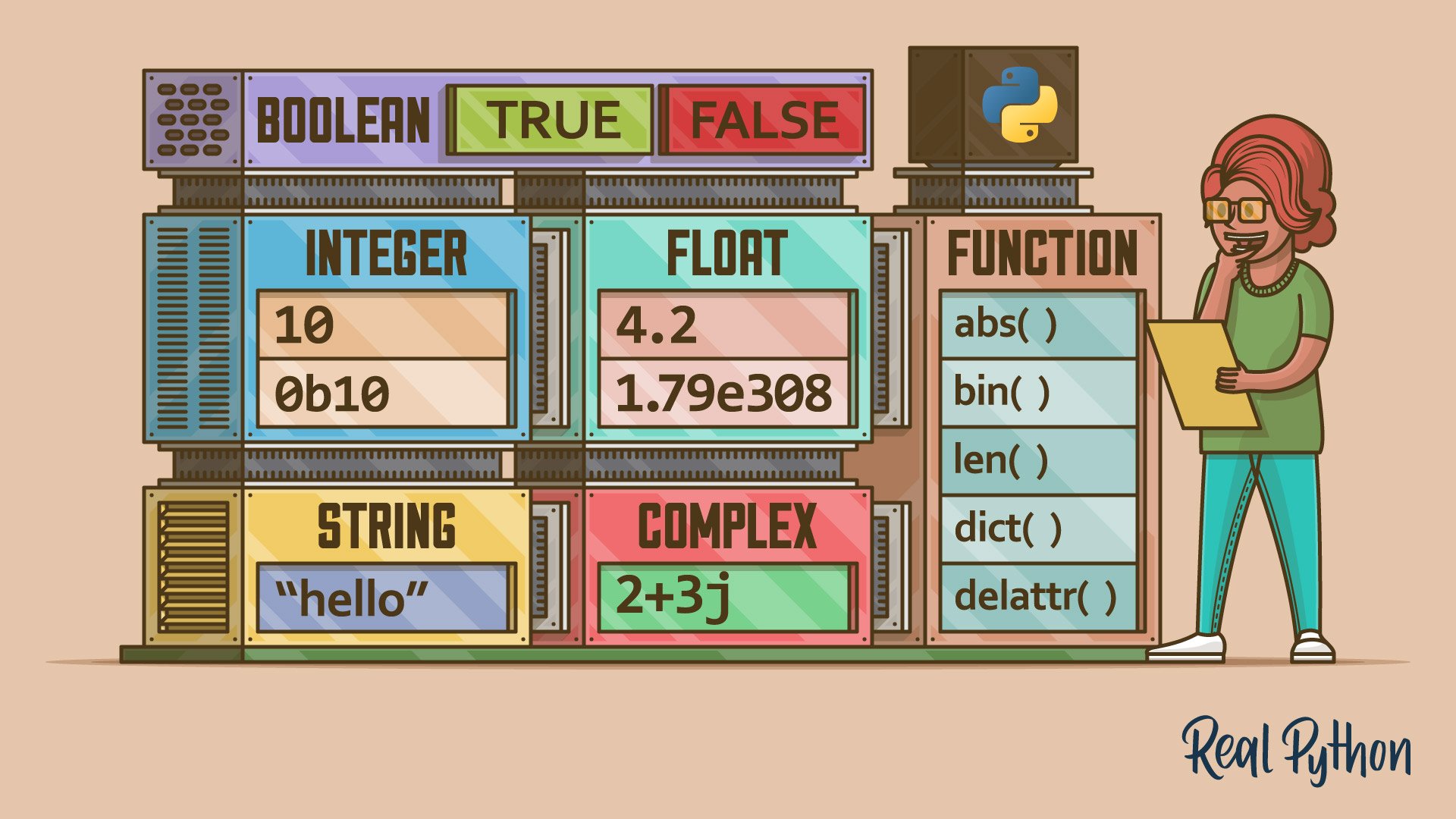
Python data types are fundamental to the language, enabling you to represent various kinds of data. You use basic data types like int, float, and complex for numbers, str for text, bytes and bytearray for binary data, and bool for Boolean values. These data types form the core of most Python programs, allowing you to handle numeric, textual, and logical data efficiently.
Understanding Python data types involves recognizing their roles and how to work with them. You can create and manipulate these data types using built-in functions and methods, and convert between them when necessary.
By the end of this tutorial, you’ll understand that:
- Python’s basic data types include
int,float,complex,str,bytes,bytearray, andbool. - You can check a variable’s type using the
type()function in Python. - You can convert data types in Python using functions like
int(),float(),str(), and others. - Despite being dynamically typed, Python does have data types.
- The most essential data types in Python can be categorized as numeric, sequence, binary, and Boolean.
In this tutorial, you’ll learn the basics of each data type. To learn more about a specific data type, you’ll find useful resources in the corresponding section.
Get Your Code: Click here to download the free sample code that you’ll use to learn about basic data types in Python.
Take the Quiz: Test your knowledge with our interactive “Basic Data Types in Python: A Quick Exploration” quiz. You’ll receive a score upon completion to help you track your learning progress: