Development of Policy Document on Impacts of Climate Change and World Heritage (2006)
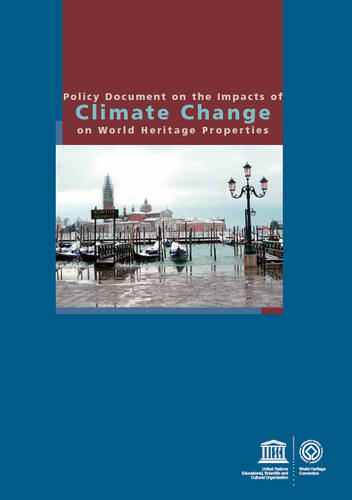
At its 30th session in July 2006, the World Heritage Committee endorsed the report on "Predicting and managing the impacts of Climate Change on World Heritage" and the "Strategy to assist States Parties to implement management responses", which were prepared following a meeting of experts in March 2006.
The World Heritage Centre is taking the following action on the different elements of the decision of the Committee:
- The Strategy and Report (as endorsed by the Committee) is being assembled into a publication in the World Heritage Paper series. It will also be put on-line in that format on the website of WHC for wider dissemination.
- A compilation of case-studies on the subject of "Climate Change and World Heritage" is also being prepared. Currently, the draft text has been sent to all those States Parties whose sites are proposed to be featured in the publication, for review and comments. Suitable photographs and other illustrations are being identified for inclusion in the publication.
- A pilot project is being developed for accessing UNEP-GEF funds for vulnerability assessment and adaptation work in selected natural World Heritage sites of Indonesia.
One of the more substantive follow-up actions to be taken on the Committee's Decision 30 COM 7.1 is the preparation of a "Policy document" on the subject, in consultation with various stakeholders (see specifically paragraph 13 of the decision). For this purpose, a two day meeting of a small group of experts, practitioners and other relevant organisations and individuals is planned to be organized on 5 and 6 February 2007 in UNESCO Headquarters in Paris. The State Party of the Netherlands has kindly offered to support this meeting and associated process.
In preparation for the proposed meeting, a draft of the policy document, in consultation with relevant experts and organizations, is being developed. This draft will be discussed and finalised by the experts at the meeting; the new draft emanating from this meeting will again be sent out to a wider group for review, in keeping with the Committee's decision.
On the issue of synergies between conventions on this issue, UNEP's Issue-based Modules (IBM) Project is being researched to help prepare a section for the draft policy document. The Advisory Bodies will help in identifying future research needs in the area of climate change and World Heritage.


Decisions / Resolutions (2)
The World Heritage Committee,
- Having examined Documents WHC/18/42.COM/7, WHC/18/42.COM/7A, WHC/18/42.COM/7A.Add, WHC/18/42.COM/7A.Add.2, WHC/18/42.COM/7B and WHC/18/42.COM/7B.Add and WHC/18/42.COM/7B.Add.2,
- Recalling Decisions 40 COM 7 and 41 COM 7, adopted at its 40th (Istanbul/UNESCO, 2016) and 41st (Krakow, 2017) sessions respectively,
- Thanks the State Party of Bahrain for having organized a World Heritage Site Managers Forum (Manama, 2018), as a capacity-building exercise aiming at increasing the understanding of the World Heritage decision-making process among site managers, in order to achieve a more effective protection of the Outstanding Universal Value (OUV); acknowledges the importance and benefit of this Forum and considers that it should be convened in conjunction with all future sessions of the World Heritage Committee;
- Takes note of the Statement of Participants to the Forum and encourages States Parties to support the participation of their respective site managers to future fora and other capacity-building opportunities in order to enable them to provide appropriate information with regard to the management of their respective sites;
Statutory matters related to Reactive Monitoring
Reactive Monitoring evaluation -
Takes note with appreciation that the World Heritage Centre has launched an evaluation of the Reactive Monitoring process and thanks the State Party of Switzerland for its financial support to this activity;
- Notes with concern that some properties have remained on the List of World Heritage in Danger for more than ten years; this raises questions on whether the OUV has been maintained and requests the World Heritage Centre to establish an inclusive working mechanism for assessing the OUV of these sites, and to present a report during the 44th session;
- Urges States Parties along with other stakeholders to actively contribute to the evaluation of the Reactive Monitoring process to ensure this mechanism remains a valuable indicator and overview of the state of conservation of heritage;
- Also takes note that the Secretariat has prepared audio-visual communication and outreach material related to the List of World Heritage in Danger;
- Encourages all stakeholders of the World Heritage Convention to engage in the promotion of a better understanding of the implications and benefits of properties being inscribed on the List of World Heritage in Danger, and to develop appropriate information material in this regard with a view to overcome the negative perceptions of the List of World Heritage in Danger;
- Requests that the Reactive Monitoring Evaluation includes options for process improvements for sites on the List of World Heritage in Danger, in particular how actions recommended by Reactive Monitoring missions to assist States Parties meet their Desired state of conservation should be incorporated into the costed Action Plans decided by the World Heritage Committee in its Decision 41 COM 14;
- Further requests the World Heritage Centre develop a proposal, for sharing in the World Heritage Market Place, for funds to support a workshop to assist States Parties with sites on the List of World Heritage in Danger to develop and implement prioritized, staged and costed actions plans, and notes that these plans can be linked to requests for international assistance and shared in the Market Place;
- Recognizing the importance of focusing on those properties of greatest concern, recommends that, with effect from the 43rd session of the Committee, the World Heritage Centre considers geographical and thematic distribution of properties as additional criteria when determining which properties to open for discussion under Agenda items 7A and 7B;
Dialogue with civil society - Welcomes the continued interest of civil society organizations in the Convention, acknowledging the important contribution that can be made to the promotion and conservation of heritage on the ground and to capacity-building;
- Also welcomes the initiative of the World Heritage Centre to open the consultation processes related to the Convention to a larger number of stakeholders, including civil society;
- Takes note of the World Heritage Civil Society Workshop organized further to the initiative of World Wildlife Fund (WWF) in March 2018, which discussed how civil society participation in the Convention, and specifically in World Heritage Committee sessions, can be further improved;
- Encourages again States Parties and civil society organizations to continue to explore possibilities to further civil society engagement in the Convention, both by contributing to enhanced conservation of heritage on the site and national level and by providing relevant input to the heritage related debate at the global level;
Emergency situations resulting from conflicts - Deplores the loss of human life as well as the degradation of humanitarian conditions resulting from the conflict situations prevailing in several countries, and expresses its utmost concern at the devastating damage sustained and the continuing threats facing cultural and natural heritage in general;
- Urges all parties associated with conflicts to refrain from any action that would cause further damage to cultural and natural heritage and to fulfill their obligations under international law by taking all possible measures to protect such heritage, in particular the safeguarding of World Heritage properties and the sites included in the Tentative List;
- Also urges the States Parties to adopt measures against World Heritage properties being used for military purposes and to stop uncontrolled development;
- Also expresses its utmost concern about the impacts of conflicts causing an escalation of the already severe poaching crisis in central Africa, as armed groups are financing their activities through illegal wildlife trade, which is having a severe impact on wildlife populations, thereby degrading the Outstanding Universal Value (OUV) of natural World Heritage properties;
- Appeals to all Member States of UNESCO to cooperate in the fight against the illicit trafficking of cultural objects and illegal wildlife trade, as well as cultural heritage protection in general, including through the implementation of the Convention on International Trade in Endangered Species of Wild Fauna and Flora (CITES), and of United Nations Security Council Resolutions 2199 (2015), 2253 (2015) and 2347 (2017) and of the 1970 Convention on the Means of Prohibiting and Preventing the Illicit Import and Export and Transfer of Ownership of Cultural Property;
Emergency situations resulting from natural disasters
- Welcomes the efforts undertaken by the World Heritage Centre to implement the Strategy for Reducing Risks from Disasters at World Heritage Properties;
- Urges States Parties, in coordination with the World Heritage Centre, to give priority within international assistance in implementing emergency measures to mitigate significant damages resulting from natural disasters that are likely to affect the Outstanding Universal Value of World Heritage properties;
- Encourages States Parties and other stakeholders to further strengthen international cooperation aiming at mitigating impacts of major natural disasters affecting World Heritage properties and reducing vulnerabilities on lives, properties and livelihoods;
Other conservation issues
Reconstruction - Thanks the Government of Poland for hosting the International Conference on Reconstruction “The Challenges of World Heritage Recovery” (Warsaw, 6-8 May 2018), providing a forum for review of specific case studies and understanding of the role of reconstruction in recovery, especially in post-conflict and post-disaster situations;
- Welcomes the Warsaw Recommendation providing clear principles on reconstruction and recovery and requests the World Heritage Centre and the Advisory Bodies to broadly disseminate it among States Parties, World Heritage stakeholders and partner organizations;
- Also requests the World Heritage Centre and the Advisory Bodies to continue the reflection and report back to its 43rd session in 2019 on the implementation of the Warsaw Recommendation;
- Encourages the ongoing cooperation with the World Bank and with United Nations agencies in addressing the challenges of World Heritage recovery and reconstruction;
Climate Change
- Expresses its continued concern about the impacts of climate change on the Outstanding Universal Value (OUV) of World Heritage properties and reiterates the importance of States Parties undertaking the most ambitious implementation of the Paris Agreement of the United Nations Framework Convention on Climate Change (UNFCCC), by holding the increase in the global average temperature to well below 2 °C above pre-industrial levels and by pursuing efforts to limit the global average temperature increase to 1.5 °C above pre-industrial levels, recognizing that this would significantly reduce the risks and impacts of climate change;
- Notes with appreciation the initiatives taken by the World Heritage Centre and the Advisory Bodies to advance work on the updating of the Policy Document on the impacts of climate change on World Heritage properties;
- Requests that the development of the updated Policy Document include consultation with States Parties, the Advisory Bodies and civil society, and be completed for consideration by the Committee at its 43rd session in 2019;
- Expresses its gratitude to the State Party of Germany for the organization of a workshop on World Heritage and Climate Change (Vilm, October 2017), to the State Party of the Netherlands for its generous support to the updating of the Policy Document and to the State Party of France for its generous support to the first global scientific assessment of climate change impacts on World Heritage-listed coral reefs;
- Thanks the Secretariat of the UNFCCC for its active participation in the above-mentioned workshop and inputs into the forthcoming broader Policy Document updating process;
Absent or unclear boundaries
- Urges States Parties that still have properties with unclear boundaries and/or buffer zones to undertake the necessary mapping exercises to clarify their boundaries and buffer zones of properties at the time of their inscription, and submit those to the World Heritage Centre for subsequent examination by the World Heritage Committee;
- Reminds States Parties that any change to existing boundaries and buffer zones must be approved by the World Heritage Committee through the applicable procedures, as outlined in paragraphs 163-167 of the Operational Guidelines;