New Inscribed Properties
2014
New Inscribed Properties Cultural properties
Bolgar Historical and Archaeological Complex
This property lies on the shores of the Volga River, south of its confluence with the River Kama, and south of the capital of Tatarstan, Kazan. It contains evidence of the medieval city of Bolgar, an early settlement of the civilization of Volga-Bolgars, which existed between the 7th and 15th centuries AD, and was the first capital of the Golden Horde in the 13th century. Bolgar represents the historical cultural exchanges and transformations of Eurasia over several centuries that played a pivotal role in the formation of civilizations, customs and cultural traditions. The property provides remarkable evidence of historic continuity and cultural diversity. It is a symbolic reminder of the acceptance of Islam by the Volga-Bolgars in AD 922 and remains a sacred pilgrimage destination to the Tatar Muslims.


Bursa and Cumalıkızık: the Birth of the Ottoman Empire
This property is a serial nomination of eight component sites in the City of Bursa and the nearby village of Cumalıkızık, in the southern Marmara region. The site illustrates the creation of an urban and rural system establishing the Ottoman Empire in the early 14th century. The property embodies the key functions of the social and economic organization of the new capital which evolved around a civic centre. These include commercial districts of khans, kulliyes (religious institutions) integrating mosques, religious schools, public baths and a kitchen for the poor, as well as the tomb of Orhan Ghazi, founder of the Ottoman dynasty. One component outside the historic centre of Bursa is the village of Cumalıkızık, the only rural village of this system to show the provision of hinterland support for the capital.


Carolingian Westwork and Civitas Corvey
The site is located along the Weser River on the outskirts of Höxter where the Carolingian Westwork and Civitas Corvey were erected between AD 822 and 885 in a largely preserved rural setting. The Westwork is the only standing structure that dates back to the Carolingian era, while the original imperial abbey complex is preserved as archaeological remains that are only partially excavated. The Westwork of Corvey uniquely illustrates one of the most important Carolingian architectural expressions. It is a genuine creation of this period, and its architectural articulation and decoration clearly illustrate the role played within the Frankish empire by imperial monasteries in securing territorial control and administration, as well as the propagation of Christianity and the Carolingian cultural and political order throughout Europe.


Caves of Maresha and Bet-Guvrin in the Judean Lowlands as a Microcosm of the Land of the Caves
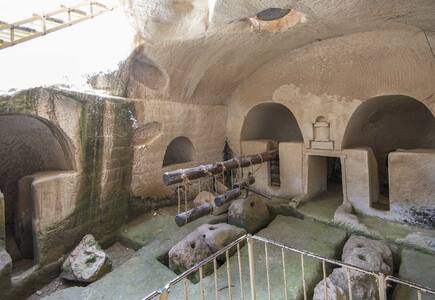
The archaeological site contains some 3,500 underground chambers distributed among distinct complexes carved in the thick and homogenous soft chalk of Lower Judea under the former towns of Maresha and Bet Guvrin. Situated on the crossroads of trade routes to Mesopotamia and Egypt, the site bears witness to the region’s tapestry of cultures and their evolution over more than 2,000 years from the 8th century BCE—when Maresha, the older of the two towns was built—to the time of the Crusaders. These quarried caves served as cisterns, oil presses, baths, columbaria (dovecotes), stables, places of religious worship, hideaways and, on the outskirts of the towns, burial areas. Some of the larger chambers feature vaulted arches and supporting pillars.


Decorated Cave of Pont d’Arc, known as Grotte Chauvet-Pont d’Arc, Ardèche
Located in a limestone plateau of the Ardèche River in southern France, the property contains the earliest-known and best-preserved figurative drawings in the world, dating back as early as the Aurignacian period (30,000–32,000 BP), making it an exceptional testimony of prehistoric art. The cave was closed off by a rock fall approximately 20,000 years BP and remained sealed until its discovery in 1994, which helped to keep it in pristine condition. Over 1,000 images have so far been inventoried on its walls, combining a variety of anthropomorphic and animal motifs. Of exceptional aesthetic quality, they demonstrate a range of techniques including the skilful use of shading, combinations of paint and engraving, anatomical precision, three-dimensionality and movement. They include several dangerous animal species difficult to observe at that time, such as mammoth, bear, cave lion, rhino, bison and auroch, as well as 4,000 inventoried remains of prehistoric fauna and a variety of human footprints.